
Email Newsletters for Financial Advisors: Why You Need Two
Why do financial advisors need two newsletters?
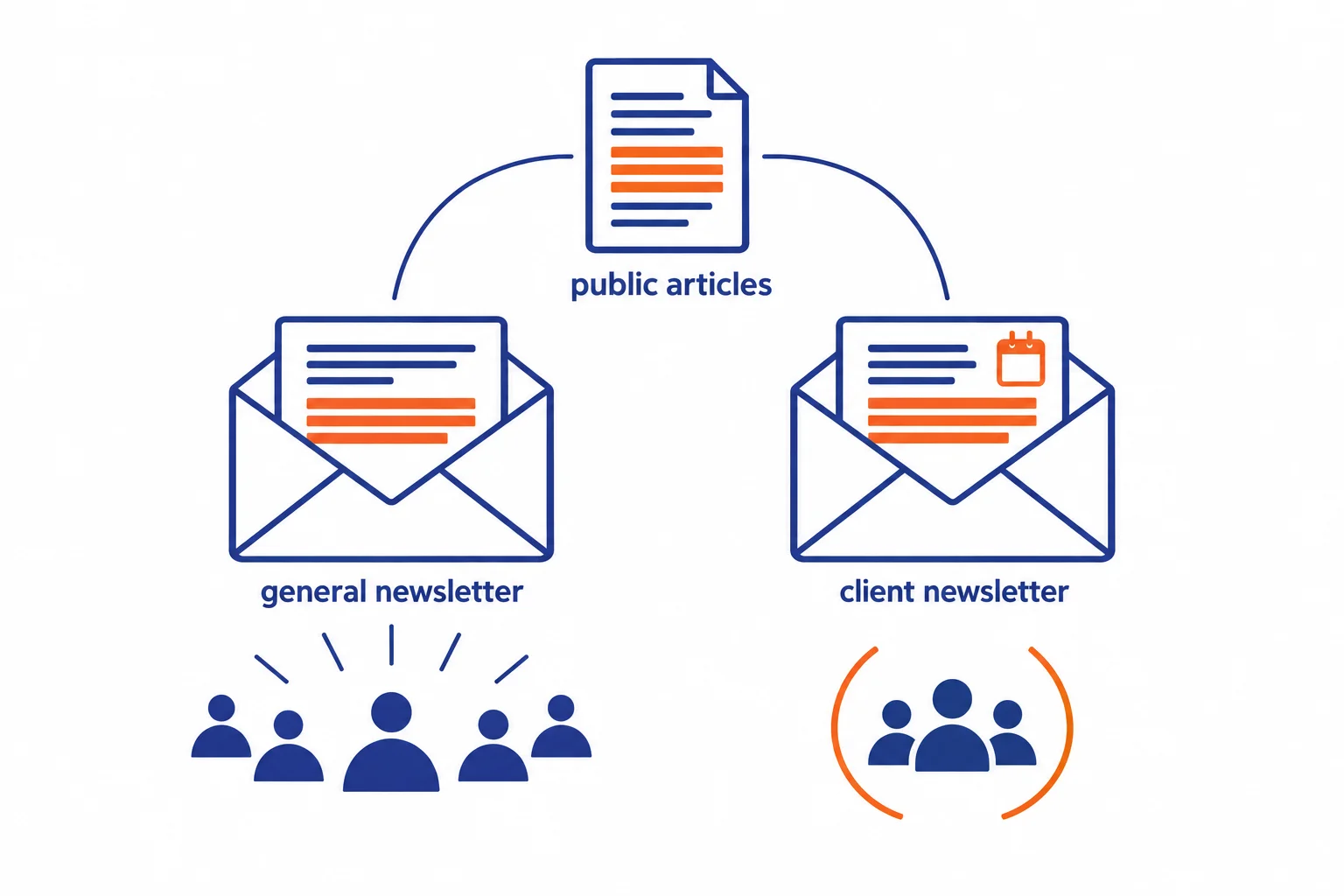
One monthly newsletter to clients, prospects, and referral partners is the minimum. Two newsletters do more: a general newsletter introduces your practice and teaches, while a client-only newsletter answers questions your clients have asked you and reminds them what to think about this time of year and at their stage of life. Both draw on public articles on your website, with different framing for the people reading them.
Get the Free Checklist to see the seven things to publish every month.
A single newsletter written for everyone at once ends up serving no one. Your clients miss what matters to them this season, and prospects get nothing that explains how you think.
A clear role for each newsletter is part of marketing for independent advisors.
Email newsletters for financial advisors don’t have to wait until client work slows down. Start with one monthly newsletter. Send it to clients, prospects, and referral partners together. That’s the minimum I recommend for every practice.
Email sends, opens, and clicks are not direct Google ranking signals. The SEO reason for sending a newsletter comes from connecting searchable public articles with readers who may find them useful and share them.
For a stronger approach, I recommend two distinct newsletters. Send a general newsletter to prospects, strategic partners, and clients too. Give existing clients a separate, client-only newsletter. Each has a different job, so each needs different content.
Awareness helps someone recognize your practice or a problem you help address. Education builds trust as you explain how to address that problem. Conversion gives an interested prospect a clear next step toward working with you. Retention helps your existing clients stay engaged in the relationship, with opportunities to become advocates.
These four marketing purposes can overlap. Your readers may be discovering your practice, considering becoming clients, or already working with you. They can enter at different points.
Your general newsletter handles Awareness, Education, and Conversion. Your client-only newsletter supports Retention. Both can draw on public articles on your website. Those articles give new readers explanations they can find through search and existing readers useful pages to revisit or share.
What does the general newsletter do?
Think about a prospect considering retirement and a CPA advising a retiring business owner. They may need the same explanation for different reasons. Your general newsletter can help both understand how you think. It can also give your clients something useful to revisit or share.
What would help a reader recognize when to talk with you? Start with the problems you address and the people you help. That makes your practice easier to recognize. It also helps an estate attorney or CPA see when you might be a fit for someone they advise.
Then give that introduction some substance. Your recently published public articles give you room to explain a question properly. Consider a proposed article titled “How much cash should I keep in retirement?” In your newsletter, you can offer a concise perspective: the decision involves balancing spending needs with the fact that holding excess cash may limit portfolio growth potential.
Now your reader has a reason to read the full article and understand the considerations behind the decision. If you simply announce a new article, you leave the reader to figure out why it is relevant.
A prospect can learn how you approach the question. A strategic partner can see when your practice might be relevant to someone they advise. Your clients can revisit the broader reasoning or forward the issue or its linked public article to a friend or family member. One public explanation can help each of them in a different way.
For a prospect who wants to explore working with you, offer a clear next step. An invitation to an introductory conversation lets them act when your explanation connects with a decision they face. Partners and clients can still find the issue useful without needing that next step themselves.
What does a client-only newsletter do?
Your clients need to know what deserves their attention now. Some of that comes from the calendar and some from where they are in life. Build this newsletter around their questions and those reminders. Help them see why a planning question belongs on the calendar now and how it connects to the work they already receive from you.
Consider retirement cash reserves again. In your general newsletter, you introduce the question: how much cash should someone keep, and what trade-offs shape that decision? In your client newsletter, you explain why revisiting those cash assumptions matters now in your work together.
If your practice reviews retirement spending needs near year-end, explain why that review includes expected withdrawals and changes in spending for the coming year. Use that framing only if it reflects the service you provide. You’re giving clients context for an existing planning conversation. They don’t need to reconsider whether they need an advisor.
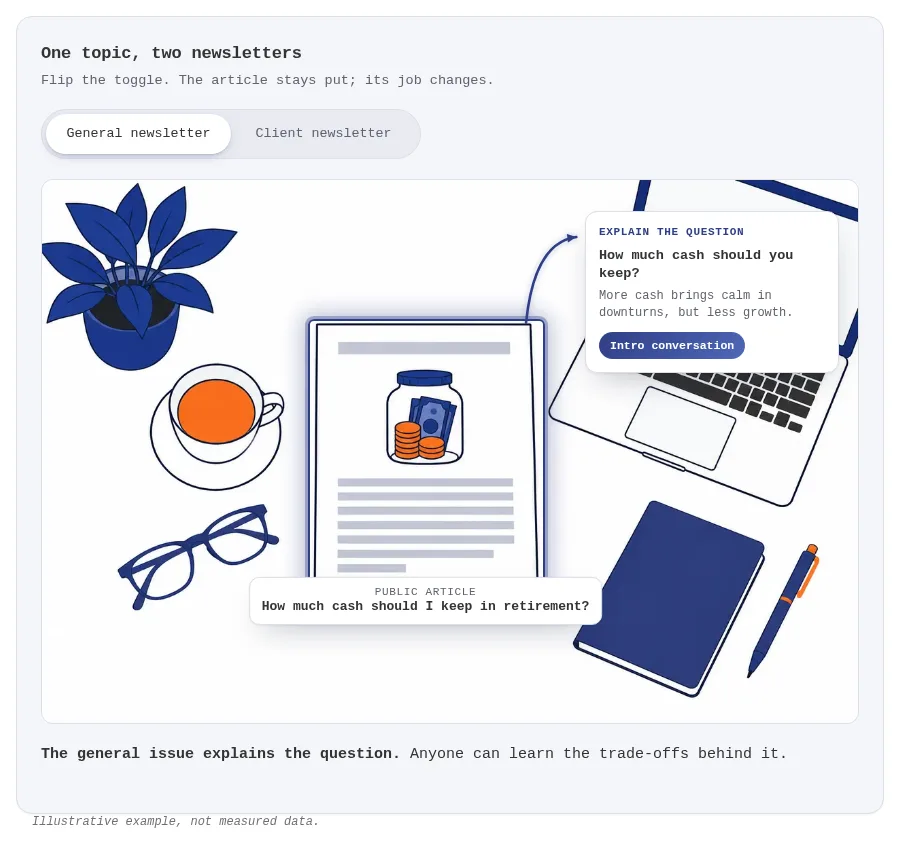
A recently published article about retirement cash can provide the background. Your newsletter can explain why clients may want to revisit it before the upcoming review period. Ask yourself, “Does this help my clients with what they need now?” A recent publication date alone doesn’t make an article relevant. An older explanation may fit better than this month’s new article.
Keep the newsletter focused on planning concerns your clients share. Account-specific advice and individualized financial details belong in each client’s own conversation with you, outside the newsletter.
Your clients can receive both newsletters without getting duplicate content. The general issue helps them understand the planning question. The client issue connects it to the current season of your work together. You’re supporting the relationship by helping clients stay informed and engaged. Continued business or advocacy remains each client’s choice.
How do newsletters connect to your website and search?
Someone searching for an explanation of retirement withdrawals may find a useful article on your site before they’ve heard of your practice. If it helps, they may subscribe to your general newsletter. A later issue can bring them back to another article and offer a next step, such as a conversation about their planning needs.
That gives someone who finds you through search a way to stay connected. Your public articles help them learn. Your general newsletter gives them a reason to return as their understanding develops.
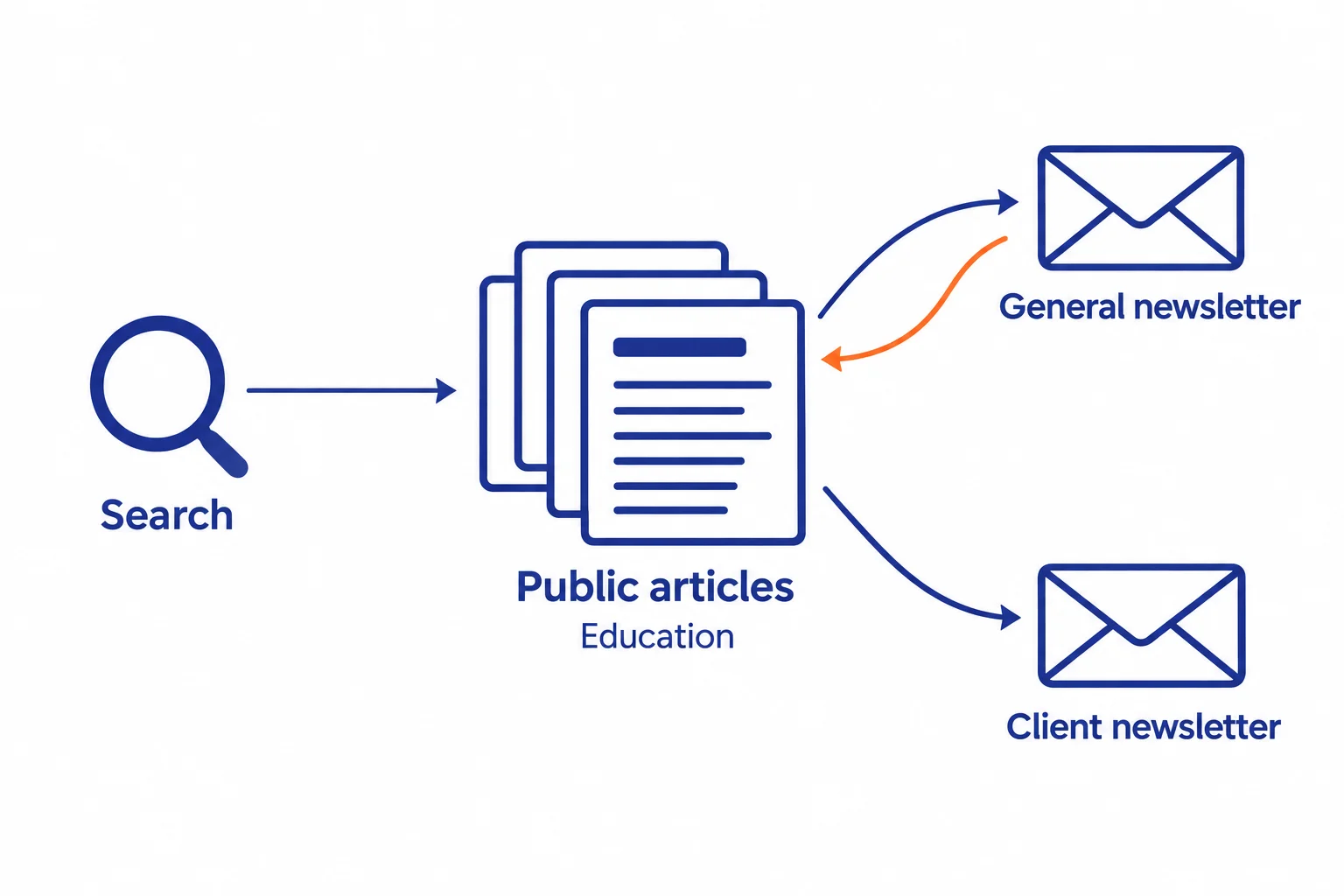
You can draw on recently published articles for both newsletters, but you’ll frame them differently. In the general newsletter, help readers understand the question and offer a possible next step. In the client newsletter, connect the explanation to the current season of your work together. Recent publication alone gives an article no ranking advantage and no automatic place in either newsletter. Choose it because it helps the reader.
Email distribution itself is not a direct ranking signal. A newsletter click is a website visit. It carries no ranking vote, and repeat visits or email engagement do not automatically improve rankings. How analytics classifies that visit depends on tagging and available referral information, including the environment the reader clicks from.
When readers forward or share your articles, they can introduce new people to your practice. Someone may later cite an article or link to it publicly. Google uses web links to discover pages and inform ranking, but distributing your newsletter guarantees neither those links nor higher rankings.
Your readers can also help you see what to explain next. A substantive question in a reply may point to something your site should address. Treat it as a reader need to consider. The reply doesn’t constitute keyword research or prove search demand. A useful answer can become a public article that you draw on in either newsletter when it fits.
How can a client newsletter lead to referrals?
A client who feels well supported may think of your practice when a friend or family member needs help. In a 2012 investor survey conducted for the SEC, 50.1% of respondents found their current adviser through a friend or family referral. Your newsletter can give a client something useful to share, though receiving it guarantees no referral.
With either newsletter, ask yourself, “Would this explanation make sense to someone outside my practice?” Give it enough context that a client can easily choose to forward the issue or a linked article. Keep linked articles public so the recipient can read them without client access.
This is your client newsletter’s strongest connection to new prospects and your website. A timely message can prompt a client to share a useful public explanation with someone who needs it. That introduces your practice to people beyond your client list. A contribution-season reminder, for example, might lead a client to forward your public IRA explanation to an adult child.
Even when someone forwards the issue, you’re still writing it for existing clients. That creates no third newsletter. Keep client-only content suitable for a newsletter, with no individualized financial details. Private correspondence stays private. Write a public explanation rather than republishing that correspondence.
Recurring seasonal questions can also help you spot a missing or outdated article worth addressing before that season returns. Verify dates, rules, and who they apply to against authoritative sources, such as the IRS rules for IRA contributions. Private email does not itself become an indexed website asset, and an individual question does not establish search demand.
Your first responsibility with this newsletter is to support existing clients. Advocacy and better public articles are possible benefits of that ongoing work.
Start each issue with something you explained to a client lately, the way you said it. Then add a reminder or two that fits. In October that might be Medicare enrollment. For a family with a child heading to college, it might be how to talk about money before they go. When you write the reminders yourself, they read as your advice. A vendor’s calendar doesn’t.
How do the two newsletters work together?
One monthly newsletter sent to clients, prospects, and referral partners together is the minimum I recommend for every practice. When you build on that baseline with two distinct newsletters, you give each a clear purpose. Newsletters are one part of your email; email marketing for financial advisors covers the other emails prospects, clients, and referral partners need.
Send your general newsletter monthly at a minimum. Your client-only newsletter also works on a steady monthly rhythm, timed to what clients care about at that point in the year. Let those seasonal concerns guide the timing within each month. Consistency matters more than frequency. Pick a pace you can keep through busy months, rather than sending more often and then going quiet. Give yourself room to keep both newsletters useful without committing to a schedule you can’t sustain.
Use your general newsletter to introduce your practice, teach through recently published public articles, and offer interested prospects a next step. Lead your client-only newsletter with a question from your own client conversations, and add seasonal reminders where they help. Draw on those articles when they help explain what deserves attention now.
In both newsletters, make useful public explanations easy for clients to share with friends or family. That gives client advocacy a path back to your website and introduces your practice to new people. Sharing and referrals remain possibilities.
The SEO connection depends on discoverable, useful website content and the opportunities newsletter distribution creates. Email activity itself is not a direct ranking signal. With two newsletters, you can address all four purposes without creating four editions or publishing more for its own sake.
FlowOps360 writes and publishes the marketing every month, in your practice’s own voice, and you approve every piece.
For a broader publishing baseline, Get the Free Checklist, “7 Things Your Practice Should Publish Every Month.” A monthly newsletter is one of the seven items.
Questions advisors ask about newsletters
How often should a financial advisor send a newsletter?
Send your general newsletter monthly at a minimum. Your client-only newsletter also works on a steady monthly rhythm, timed to the seasonal concerns clients have at that point in the year. Choose a pace you can keep through busy months. Consistency matters more than sending more often and then going quiet.
What should a financial advisor newsletter include?
A financial advisor newsletter should give readers a useful explanation and a reason to care. In a general newsletter, introduce the problems you help address, draw on public articles, and offer interested prospects a clear next step. Your client-only newsletter should explain what deserves attention now within your ongoing work together.
Should clients and prospects get the same newsletter?
Clients can receive your general newsletter alongside prospects and referral partners. I also recommend a separate client-only newsletter. The general issue introduces and explains planning questions; the client issue connects relevant explanations to the current season of your work together. Different purposes and framing let clients receive both without duplicate content.
Do email newsletters help a financial advisor's search ranking?
Email sends, opens, and clicks are not direct Google ranking signals. Newsletters can bring readers to useful public articles on your website and give them something to share. Someone may later cite or link to an article publicly, but newsletter distribution guarantees neither those links nor higher search rankings.
Sources
- 3 Reasons to Consider Putting Your Cash to Work — Charles Schwab
- Default channel group — Google Analytics Help
- Make your links crawlable — Google Search Central
- Investor Research Report — Siegel & Gale LLC
- Publication 590-A (2025), Contributions to Individual Retirement Arrangements (IRAs) — Internal Revenue Service