
Launch Day Is Week Nine
What financial authors get wrong about launching a book or course
Most launches are planned backward from a single date. The book ships. The course opens. Everything points at that morning.
Then the morning arrives, a few posts go out, an email goes out, and the numbers are quiet.
The launch did not fail that day. It failed eight weeks earlier, when nothing was happening.
Three Ways Financial Launches Break
1. The single-channel push
A handful of social posts and one email blast on launch day. No warming runway ahead of it.
Nobody buys a course from a stranger on first contact. A prospect who has never encountered your thinking needs to move from unaware, to interested, to convinced. That sequence takes weeks. Compressing it into one morning does not speed it up — it skips it, and the conversion rate shows exactly that.
2. Review arriving late
In wealth publishing, claims about returns, strategy outcomes, or tax savings get attention during review. That is the system working.
The failure is drafting launch copy piecemeal in the final fortnight. Material reaches your compliance reviewer with no room, and a hard launch date starts depending on how fast someone else can read.
3. Everything stops on day fourteen
Launch week ends and the marketing ends with it. Weeks of work produce a spike, then nothing.
The assets were fine. They were built for one date and never used again.
The Twelve-Week Runway
A launch runway runs in three four-week phases across long-form articles, social posts, email, and lead magnet assets.
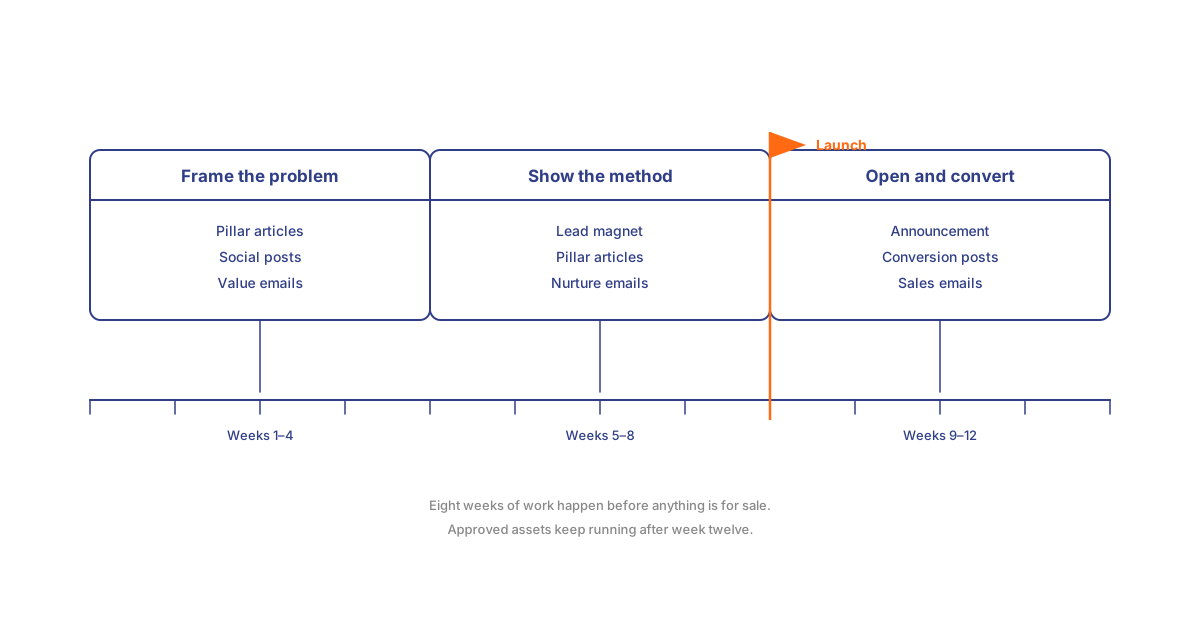
The shape matters more than the contents. Two thirds of the work happens before anything is for sale.
Phase 1: Frame the problem (Weeks 1–4)
Goal: change how your audience sees their problem. No pitch yet.
At minimum this phase produces two long-form core articles, twelve social posts, and two email broadcasts.
The articles establish what is broken about the standard approach — the piece that argues why traditional tax strategy fails founders during a liquidity event, for instance. The social posts carry the sharpest claims from those articles. The emails go to the audience you already have, and their real job is telling you which angle lands before you commit the next eight weeks to it.
Nothing here mentions the product.
Phase 2: Show the method (Weeks 5–8)
Goal: introduce your framework and turn readers into a waitlist.
At minimum: one downloadable guide, two more long-form articles, twelve social posts, and three nurture emails.
The guide is the entry point — a checklist, a blueprint, an audit framework. Something with standalone value that also makes clear you have a method. The articles position that method against the alternatives. The social posts drive to the guide rather than to the product, because the product is not open.
By week eight you know who is paying attention, and they know what you actually think.
Phase 3: Open and convert (Weeks 9–12)
Goal: open, convert, and keep the assets working.
At minimum: two conversion articles, twelve social posts, and three sales emails.
Week nine is the announcement and the deep-dive breakdown. The social posts carry proof and specifics. The emails run the open, the questions everyone asks, and the closing notice.
Then the part most launches skip. Approved posts from all twelve weeks go back into rotation on a rolling schedule afterward, so the material that took three months to build keeps bringing people in through the following quarter. A launch produces its own library by week twelve. Most authors let it sit.
What This Costs You in Hours
The runway starts with one sixty-minute launch architecture interview. That conversation sets the positioning, the audience, the framework, and the sequence.
After that, a forty-five-minute alignment meeting every two weeks — six across the twelve weeks.
That is the whole demand on your calendar. You do not draft copy, approve rounds of design, or schedule anything. Execution strategists produce the material and it publishes on the runway schedule.
One requirement: the launch needs a fixed date before week one. Without a date there is no runway, only a content plan.
Compliance on the Runway
Every deliverable is reviewed against your brand and claims profile as it is produced — not batched into one screen at the end. Guarantee language, performance claims, and missing disclosures get caught while there is still time to change them.
The full launch suite arrives as an auditor-ready compliance export package: at minimum six pillar articles, thirty-six social posts, eight email broadcasts, and the guide, with time-stamped copy, visual assets, and review records.
Your compliance reviewer receives it on the runway schedule, with the material in hand well ahead of the date. What they need for their review, when they need it. Their turnaround and any revisions they ask for remain theirs — that is the point of having a reviewer.
Launching Without the Nights and Weekends
A launch that works is not a burst of effort in week twelve. It is twelve weeks of small, sequenced, deliberate moves, most of them happening before anyone can buy.
You supply the thinking in about five and a half hours spread across three months. The runway supplies everything else.
Ready to plan one? Book a demo and we will walk you through the twelve-week framework — how the phases sequence, what gets produced when, and how the compliance package is assembled.