
Multi-Desk Firm Architecture: How to Scale Practice Desks Under One Roof Without Voice Bleed
A founder on your list opens your newsletter. The subject line is about protecting a family legacy across generations.
He is thirty-four. He has unvested equity and no estate.
Nobody was careless. The email went out through the same pipeline everything else does, and it reached the wrong audience in the wrong language. He does not reply. He does not unsubscribe either. He simply revises his estimate of how well your firm knows people like him.
That revision is the cost, and you never see it happen.
As wealth management practices scale, they organize around specialized desks. Financial Advisement. Tax. Estate Planning. Specialization is how a firm wins high-net-worth share.
That structure creates a brand voice problem. Voice bleeds across desks, and it bleeds across ICP profiles inside them.
Separating your Tax desk from your Estate Planning desk is not enough. Every desk under your roof needs its own ICP topic profiles.
Two examples.
A Tax article for a VC Founder covers QSBS stacking and 83(b) elections. A Tax article for a HNW Physician covers practice K-1 distributions and 1099 optimizations. Same desk. Different vocabulary entirely.
An Estate Planning campaign for a founder holding unvested options needs a different topic map than one for a physician protecting personal assets against medical malpractice tail liability.
When topic boundaries blur, prospects sense it. Keyword sets bleed across desks and profiles, and true specialization stops reading as real.
A Two-Minute Test
Take the last marketing piece from two of your practices. Remove the logos.
Hand both to someone who does not work at your firm.
Can they tell which practice wrote which?
If they cannot, your specialization exists in the org chart. It exists in your advisors’ heads. It does not exist in your marketing, and marketing is the only version of your firm a prospect meets before the first call.
The Danger of Voice & Keyword Bleed
The primary fear is not administrative overhead. It is losing credibility in a high-value niche because the copy uses the wrong topics, terms, or context for that specific buyer.
The breakdown happens in two layers.
1. Desk-Level Bleed (Financial Advisement vs. Tax vs. Estate Planning)
A client researching estate preservation receives dense corporate tax filing commentary. Or high-velocity investment accumulation copy. The positioning collapses. The firm stops looking like a set of specialized desks and starts looking like a generic service aggregator.
2. ICP-Level Bleed (Within Each Practice Desk)
The wrong language gives you away inside a single desk. Send VC Founder equity tax copy to a HNW Physician, and you signal that your team does not understand her operational reality.
This layer costs more, because it is harder to notice.
A prospect forgives the wrong topic. It reads as a list error, and everyone has been on the wrong list. What no one forgives is the right topic in the wrong language. That reads as a competence judgment, and it gets made inside a paragraph.
Why Discipline Does Not Fix This
The instinct is to treat bleed as a diligence problem. Write tighter briefs. Remind the writers. Have each desk lead review their own copy before it goes out.
That works for a quarter. Then it decays.
It decays because the structure never changed. One house voice sits underneath, and every desk draws from it. Each piece starts in the same place. Someone then pulls it toward the specific audience, if they are paying attention that week.
Attention is not a structure. When it lapses, the copy returns to the house voice, because the house voice is the default and nothing prevents it.
There is a second cost here, and it is the one that stalls firms.
Your desk leads have professional reputations inside small, specific communities. When copy produced for their desk reads like it came from the house rather than from them, they will not put their name on it. Output stops. You are now holding brand governance over advisors you do not directly manage, with no mechanism to enforce it.
The 3 Pillars of Multi-Layered Voice Architecture
Firms scaling this way implement three structural safeguards. The result is three desks marketed across multiple ICP profiles, under one master brand, without voice or keyword contamination.
Pillar 1: Desk-Specific & ICP-Specific Brand DNA Profiles
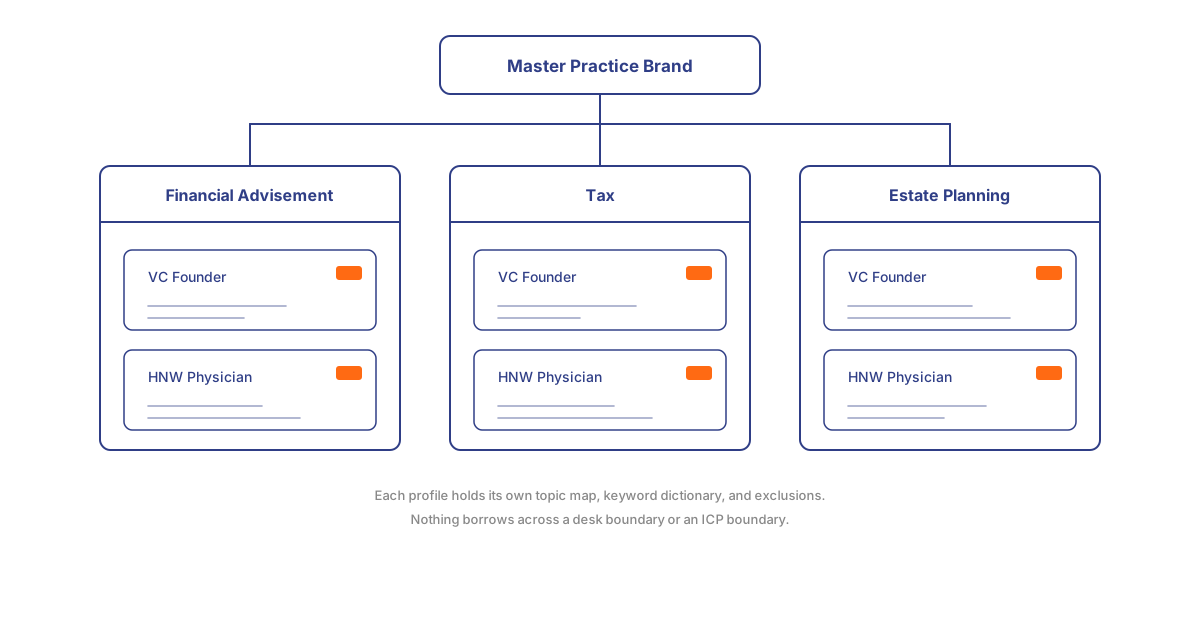
Every practice desk maintains a strictly isolated Brand DNA Profile. So does every ICP topic profile inside it. The isolation lives at the database level.
Each profile holds three things:
- ICP-Specific Topic Maps: Pre-approved themes for the intersection of desk and buyer. Tax Desk → VC Founder is not Tax Desk → HNW Physician.
- Niche Keyword Dictionaries: The required vocabulary and technical terms that establish peer-level credibility on the first read.
- Negative Keyword & Topic Exclusions: Terms, phrases, and topics explicitly banned from that profile, so nothing cross-contaminates.
A Tax campaign targeting VC Founders picks up physician medical terminology. The pre-scan flags the keyword collision before human review.
Profiles are scoped as finely as the distinction requires. Where one desk serves two audiences that share a subject and share nothing else, that is two profiles. It is two different pieces of writing regardless of who signs them.
Pillar 2: Decentralized Advisor Briefings
Lead advisors run different desks. None of them will spend weekends writing copy or editing generic drafts.
So the briefing decentralizes instead:
- Lead advisors share raw insights, real-world client scenarios, and market perspective in a structured briefing with an Execution Strategist.
- The Execution Strategist captures the advisor’s natural industry language. Those insights become bespoke articles, social posts, and newsletters.
- Every piece is built from that profile’s exact keyword dictionary and topic parameters. Each one sounds like the desk it came from, without taking hours from the advisor.
The advisor writes nothing. Edits nothing. Schedules nothing.
That is why they sign it. The material came from them, so their name on it costs them no reputation.
Pillar 3: Centralized Governance (With Per-Desk CCO Export Packages)
You monitor firm-wide output from a Central Brand Governance Dashboard. From there you verify that messaging across Financial Advisement, Tax, and Estate Planning stays isolated across every ICP topic profile.
This is the view you could never assemble when several desks were handled by several sets of hands.
Compliance review works differently:
- The CCO never receives a software login.
- Compliance leads receive dedicated, per-desk Auditor-Ready Compliance Export Packages (PDF).
- Each package holds time-stamped copy, visual assets, pre-scan keyword verification logs, and digital sign-off records formatted for SEC and FINRA recordkeeping requirements.
You govern brand voice and topic isolation from the dashboard. The CCO receives clean, per-desk audit packages. Operations stay fast, compliant, and completely isolated.
Your CCO stays the approver they have always been. Nothing here asks them to move faster or care less.
Managed Distribution Across Segmented Audiences
Once sign-off is complete, our team manages 100% of formatting, scheduling, and distribution.
Articles publish to the matching blog desk category. Email broadcasts reach only the contact list segment assigned to that desk and ICP topic profile. Tax Desk content for VC Founders goes to VC Founder contacts, and nowhere else.
One desk serving two audiences means two sends. Not one send to a merged list.
Three Objections Worth Answering
“Our structure is more complicated than that.”
Multi-brand governance is the capability, not an accommodation. Isolated profiles per sub-practice under one central dashboard is the architecture, whether you run three desks or ten, one entity or several DBAs.
“The sub-brands will drift back to a house voice within two quarters.”
They cannot drift toward something that is not there. Each profile holds its own voice, negative keywords, and audience nuance. Nothing borrows across a profile boundary, and no shared house voice sits underneath waiting to reassert itself.
“Producing content for that many distinct niches means hiring that many agencies.”
One engine. One dashboard. One subscription that scales by desk, not by vendor. The separation is structural, so it does not require separate vendors to maintain it.
Scale Your Practice Without Losing Topic & Voice Precision
You do not have to homogenize your marketing to scale multiple practice areas.
Build isolated Brand DNA profiles with dedicated ICP keyword dictionaries for every desk. Use structured advisor briefings. Maintain central brand governance. Deliver per-desk CCO export packages.
Your firm markets Financial Advisement, Tax, and Estate Planning so each one sounds like itself.
Then run the test again in six months. Remove the logos. Hand two pieces to someone outside the firm.
They should be able to tell which desk wrote which. That is the whole reason you built more than one.
Ready to see how desk-level voice isolation works in practice? Book a demo and we will walk you through the governance framework — how each desk keeps its own voice as your firm scales.